Voice search optimization for Indian businesses is worth a light, low-cost effort in 2026, but not a separate marketing budget. The things that help most, such as a complete Google Business Profile, clear answers to customer questions, and content in the languages your customers actually speak, also improve ordinary search. This guide separates what’s reliably true from the hype, covers what changed with Google’s AI search in India, and lists what to do and what to skip.
Quick Answer: Yes, prepare, but treat voice as part of local SEO and answer-first content, not a standalone project. Voice queries in India lean toward Hindi, Hinglish, and regional languages, and often have local intent. Fix your Google Business Profile, write plain-language answers to real customer questions, keep your details consistent, and make your mobile site fast. Don’t trust any specific “X% of searches are voice” figure, since published numbers conflict.
Key Takeaways
- The direction is clear but the numbers aren’t: sources agree voice use in India skews toward Hindi, Hinglish, and regional languages and local questions, but published shares of voice searches range widely.
- Google launched Search Live, a voice and camera conversation feature, in India in English and Hindi in October 2025, and expanded AI Mode to seven more Indian languages.
- Most of the preparation overlaps with local SEO: Google Business Profile, reviews, consistent details, and fast mobile pages.
- Building custom voice apps or buying “voice SEO packages” is rarely worth it for a small business.
- Local businesses such as restaurants, clinics, salons, and shops benefit most; many B2B businesses less so.
What the Data Can and Can’t Tell You
Voice search statistics for India are all over the place, so use the direction, not the percentage. Sources I checked put the share of voice-based searches in India anywhere from roughly 28% to 34%, and one claims “over 50%,” echoing an old, widely repeated claim that circulated years ago and was never reliably sourced. Several agency pages quote the same figures without a traceable primary source.
What is consistent: voice queries lean toward Hindi, Hinglish, and regional languages, and many carry local intent, such as “near me” questions. That’s enough to guide action without trusting any single number.
What Changed in 2026: Search Live and AI Mode
Google’s own announcements make the direction concrete: voice and conversational search are being built into Google Search for Indian languages. In October 2025, Google brought Search Live, a feature in AI Mode that lets people talk to Search and use their camera, to India in English and Hindi. India was the first country outside the US to get it, according to Google’s India blog.
Google also expanded AI Mode to Bengali, Kannada, Malayalam, Marathi, Tamil, Telugu, and Urdu. Google has since listed further Indian-language expansion for Search Live, so check current availability. This makes answer-first, conversational content more valuable, since these tools summarise and speak answers instead of listing ten links.
Who Should Care Most
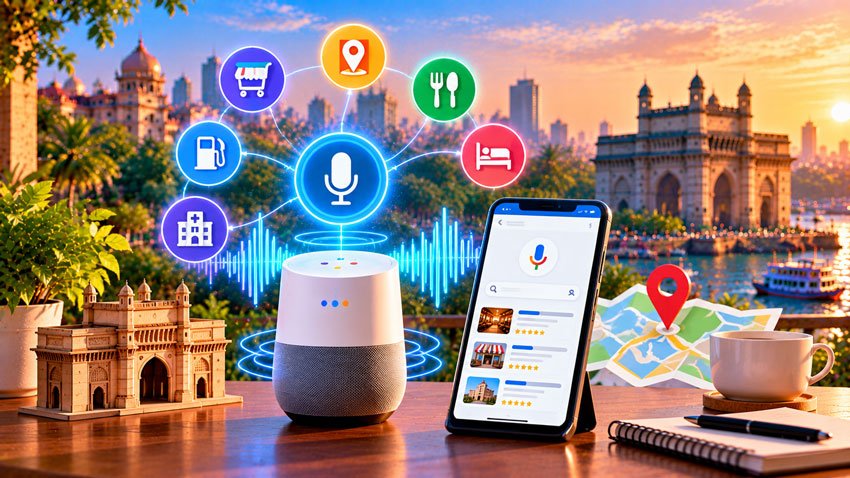
Businesses where customers ask nearby, practical questions get the most from voice preparation. Think of someone asking for a restaurant open now, a salon with parking, or a clinic near their home.
| Business Type | Priority | Why |
|---|---|---|
| Restaurants, cafés, salons, clinics | High | Customers ask local, immediate questions |
| Retail shops and kirana stores | High | “Near me” and “is it open” queries |
| Local service providers (repairs, tutors) | Medium–High | Mix of local and comparison queries |
| B2B and online-only businesses | Lower | Fewer voice-style, location-driven searches |
What to Do Now
Start with the free, high-impact basics, in this order.
- Complete your Google Business Profile. Accurate hours, categories, services, photos, and answers in the Q&A section. See our Google Business Profile optimization guide.
- Keep your name, address, and phone number identical across your website and directory listings.
- Write answers to real customer questions. Use plain, conversational phrasing and put the direct answer first, followed by detail.
- Add Hindi or regional-language content where your customers speak it, rather than relying on English alone. Our guide to AI tools for Hindi content explains how to do this without stiff, translated-sounding text.
- Make your mobile site fast. Most voice queries happen on phones, so see our landing page mistakes guide for speed fixes.
- Add structured data where practical, such as local business and FAQ markup. It helps search engines understand your pages but doesn’t guarantee a spoken answer.
What to Skip
Skip custom voice apps and expensive “voice SEO” packages. Some older guides recommend building Alexa Skills or similar voice apps, but for a small business that’s rarely worth the cost, and some of that advice is out of date.
Also avoid stuffing awkward question phrases into every page. Write naturally for people, as the rest of your SEO should be, and let the clear, helpful answer do the work.
How to Test Your Own Visibility
The most useful test is also the cheapest: speak your customers’ questions into your phone and see what comes back. Try them in English, Hindi, and Hinglish, such as “best salon near me” or the Hindi equivalent, and note whether you appear.
Then open Google Search Console and look for question-style queries that already bring people to your site. Those are the topics to answer more clearly. Revisit the test every few months, since AI search features are changing quickly.
Common Mistakes
The biggest mistake is treating voice search as a new, separate channel instead of an extension of local SEO. Another is chasing a headline statistic and spending money on the assumption that most searches are now spoken. A third is ignoring language: an English-only site can miss customers who speak Hindi or Hinglish.

Frequently Asked Questions
Q1. Is voice search optimization worth it for small businesses in India?
In a light-touch way, yes. Most of the work overlaps with local SEO, so you’re improving your visibility in general, not buying a separate service.
Q2. What percentage of searches in India are voice searches?
Published figures vary widely, from roughly 28% to over 50%, and many aren’t traceable to a reliable source. Treat the direction as useful and any exact number with caution.
Q3. Does Google support voice search in Hindi and other Indian languages?
Yes. Google has launched Search Live in India in English and Hindi, and expanded AI Mode to several other Indian languages, with further expansion reported.
Q4. Do I need to create content in Hindi or regional languages?
If your customers speak them, it’s worth doing, since voice queries often use Hindi, Hinglish, or regional languages. Write naturally in the language rather than translating word for word.
Q5. Should I build an Alexa skill or voice app?
Usually not. For most small businesses, a strong Google Business Profile and clear website answers deliver far more value for the effort.
Conclusion
Voice search optimization for Indian businesses in 2026 comes down to doing the fundamentals well: a complete Google Business Profile, consistent details, plain answers to customer questions in the right languages, and a fast mobile site. Test your visibility by speaking your own queries, avoid hype and expensive add-ons, and revisit as Google’s Indian-language AI search keeps developing.