
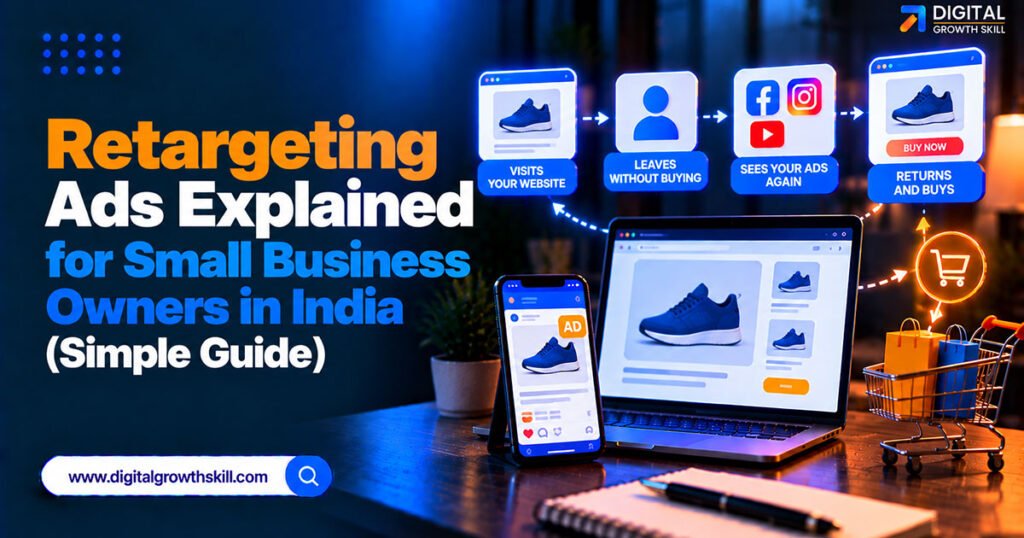
Retargeting Ads Explained for Small Business Owners in India solve a specific problem: most people who visit your website or click a WhatsApp link don’t buy the first time, and retargeting is how you show up again for the ones who were genuinely close. This guide explains how it actually works in plain terms, what’s changed about setting it up in 2026, and a consent requirement under India’s DPDP Act that’s easy to miss.
Quick Answer: Retargeting shows ads specifically to people who already visited your website or engaged with your business, using a small tracking code (a “pixel”) plus, increasingly, a server-side backup called the Conversions API, since browsers and consent choices now block a meaningful share of pure pixel tracking. You need visible consent before these trackers fire under India’s DPDP Act, and platform-reported results for retargeting tend to look better than they really are, since they count people who may have bought anyway.
Key Takeaways
- Retargeting means showing ads to people who already interacted with your business, not cold strangers — this is why it typically converts better than a first-time awareness campaign.
- Pixel-only tracking now misses meaningful data due to ad blockers, browser privacy settings, and consent requirements, which is why Conversions API (server-side tracking) has become standard alongside it in 2026.
- A visible consent notice before tracking pixels fire isn’t optional under India’s DPDP Act, since this is personal data collection the same as any form.
- Platform-reported retargeting ROAS commonly looks inflated, because it often counts people who were already likely to purchase, not just those the ad genuinely convinced.
- Capping how often the same person sees your retargeting ad, and excluding recent buyers, keeps the tactic from feeling intrusive.

What Retargeting Actually Is, in Plain Terms
Retargeting shows ads specifically to people who’ve already visited your website, clicked your WhatsApp link, or engaged with your social content — not to strangers who’ve never heard of you. If someone browsed your product page and left without buying, retargeting is what lets your ad follow up with them later, rather than that visit simply disappearing into nothing.
This is different from “remarketing,” a term Google uses specifically for its own list-based ad audiences; in everyday use, most small business owners hear “retargeting” and “remarketing” used fairly interchangeably.
How It Technically Works: Pixel, Tags, and Server-Side Tracking
A small piece of tracking code — the Meta Pixel on Facebook and Instagram, a remarketing tag on Google — sits on your website and notices when someone visits a page, adds something to a cart, or completes a purchase. That activity builds an audience list you can then target with ads.
The part that’s changed by 2026: pixel tracking alone now misses a meaningful share of activity, since browsers increasingly restrict cross-site tracking, many users decline tracking consent, and ad blockers filter pixels outright. Both Meta and Google now recommend pairing the browser pixel with server-side tracking — Meta’s Conversions API, Google’s Enhanced Conversions — so some of that missing data reaches the platform through your website’s own server instead of the visitor’s browser.
Setting Up Retargeting on Meta and Google
Basic pixel installation is something most website builders or a developer can set up in under an hour; the server-side Conversions API layer is more technical and usually benefits from developer help. For Meta, this means creating a pixel in Events Manager and adding it to your site; for Google, it means adding a remarketing tag through Google Ads or Google Tag Manager.
If you’re not comfortable with the technical setup yourself, this is a genuinely reasonable task to hand to a developer or agency rather than attempting a half-finished DIY version — a broken or partially configured pixel quietly undercounts your actual results.
A Simple Use Case for Indian Small Business
The most common, highest-value retargeting setup for a small Indian business is showing a follow-up ad to people who viewed a product or service page but didn’t complete a purchase or send a WhatsApp enquiry. This captures genuine interest that would otherwise be lost, without spending budget on people who’ve shown no interest at all.
For COD-heavy businesses specifically, remember that a pixel can’t see an offline or in-store purchase — someone who browsed online and later bought in person at your shop still shows up as “didn’t convert” unless you manually exclude them, which is worth accounting for when judging retargeting performance.
The DPDP Consent Requirement You Can’t Skip
Tracking pixels collect personal data the moment they fire, and under India’s DPDP Act, that requires clear, informed consent before collection begins, the same principle covered in our guide to building an email list without running ads. A visible cookie or tracking consent notice, with a genuine way to decline, isn’t just good practice — it’s the legal basis your retargeting audience is built on.
This also directly affects your results: when someone declines consent, their activity generally can’t feed your retargeting audience, which is part of why server-side tracking alone can’t fully substitute for consent-respecting setup.
Don’t Annoy People: Frequency and Exclusions
Showing the same retargeting ad too often turns a helpful reminder into an annoyance, and recent industry guidance suggests roughly 5 to 7 impressions per person over a week is a reasonable range for warm retargeting, not a fixed rule, but a sensible starting point to test against your own results. Beyond frequency, exclude people who already purchased from your retargeting audience — showing an ad for something someone just bought wastes budget and looks careless.
Why Retargeting ROAS Numbers Can Be Misleading
Retargeting campaigns often report an unusually strong return on ad spend, partly because they’re reaching people who were already close to buying — some of whom would have purchased anyway, with or without seeing the ad. This doesn’t mean retargeting doesn’t work; it means the platform’s own reported number overstates how much of that result the ad actually caused.
A simple way to get a more honest read, if your volume allows it, is holding back a small portion of your retargeting-eligible audience from seeing ads at all and comparing their conversion rate to the group that did.
Common Mistakes Small Businesses Make With Retargeting
Running retargeting with no frequency cap, letting the same person see an ad dozens of times in a week, is one of the most common ways to waste budget and damage brand perception at once. Skipping consent setup entirely, assuming it only matters for large companies, is a mistake that carries real compliance risk rather than just a wasted ad spend.

Frequently Asked Questions
Q1. Is retargeting worth it for a small business with a small website audience?
It can be, but you generally need enough website visitors or engaged users to build a meaningful audience first. Very low-traffic sites may need to grow traffic before retargeting has enough people to show ads to.
Q2. Do I need a developer to set up retargeting?
Basic pixel installation is manageable for many business owners or a general website developer. The server-side Conversions API layer is more technical and often worth handing to someone experienced with it.
Q3. Is retargeting legal under India’s DPDP Act?
Yes, with proper consent. Tracking pixels collect personal data, so a visible, genuine consent notice before they fire is required, the same principle that applies to any other personal data collection on your site.
Q4. How often should someone see my retargeting ad?
Recent guidance suggests roughly 5 to 7 impressions over a week for warm retargeting audiences as a reasonable starting range, adjusted based on your own results rather than treated as fixed.
Q5. Why does my retargeting ROAS look so much better than my other campaigns?
Partly because retargeting reaches people already close to a decision, some of whom may have converted regardless of the ad. Treat a very high reported ROAS with some skepticism rather than as pure incremental results.
Conclusion
Retargeting ads for small business owners in India work by reconnecting with people who already showed real interest, using a tracking pixel increasingly paired with server-side tracking to capture activity browsers now block. Set it up with genuine DPDP consent in place, cap how often the same person sees your ad, and read platform-reported ROAS with healthy skepticism rather than at face value — retargeting is a genuinely useful tactic, just not quite as effortlessly profitable as the numbers in your ads dashboard might suggest.