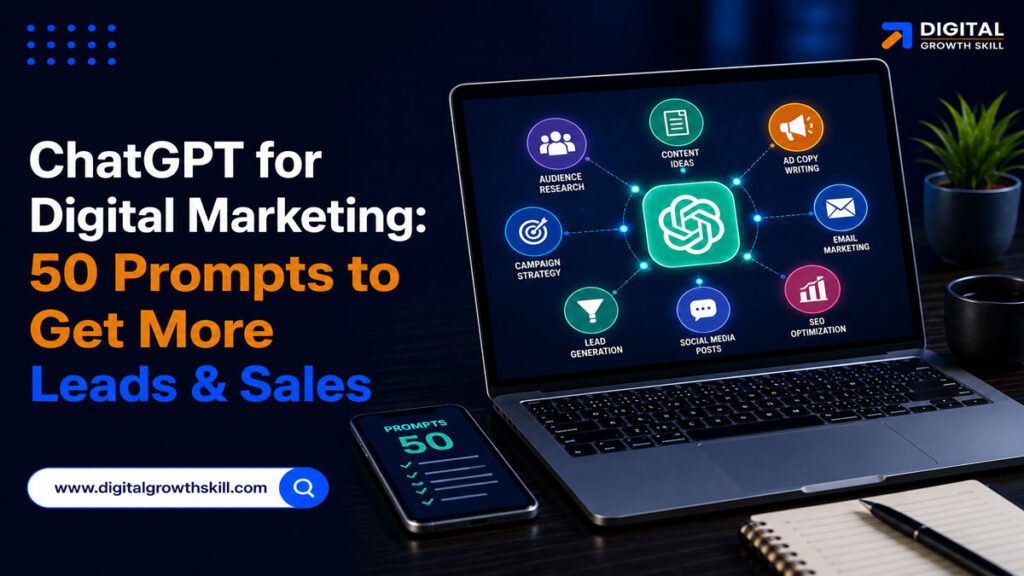
When talking about ChatGPT for digital marketing in 2026, this is really a powerful way for marketers and business owners to speed up content creation, campaign planning, customer research and lead generation. Instead of using AI only for writing, marketers can use well-structured prompts to support different stages of the customer journey.
From social media posts and ad copy to email campaigns, lead magnets and sales messages, the right prompts can help marketers work more efficiently. However, ChatGPT works best when marketers provide clear business information, target audience details and specific goals rather than relying on generic instructions.
Advantages of ChatGPT Prompts for Digital Marketing
- Faster marketing content creation
- More campaign ideas
- Better lead-generation strategies
- Improved sales copy
- Reduced repetitive marketing work

Below are the best ChatGPT prompts for digital marketing in 2026 & beyond –
1. Start With Your Customer, Not Your Content
One of the most common marketing mistakes is starting with:
“What should I post today?”
A better question is:
“What does my target customer actually need?”
Once you understand customer problems, concerns, questions and buying motivations, content and campaigns become easier to create.
ChatGPT can help you organize this research into useful marketing insights.
2. Turn Customer Problems Into Content
Once you’ve identified customer questions and pain points, turn them into content.
Instead of randomly publishing posts, build your content around the things your audience actually wants to know.
3. Use AI to Improve Your Social Media Workflow
Social media managers often spend more time thinking about what to publish than actually creating it.
ChatGPT can help turn a single idea into multiple pieces of content.
4. Build Better Lead-Generation Campaigns
Traffic and followers are useful, but businesses ultimately need customers.
ChatGPT can help you think through the journey from attracting attention to capturing a lead.
A basic funnel might look like:
Content → Lead Magnet → Landing Page → Form → Follow-Up → Sales
Each step needs a clear purpose.
5. Use ChatGPT to Develop Better Ads
Advertising becomes expensive when businesses repeatedly launch campaigns without testing different messages.
Instead of asking AI for one advertisement, ask it to explore multiple angles.
For example:
- Problem-focused
- Benefit-focused
- Outcome-focused
- Comparison-focused
- Trust-focused
- Urgency-focused
6. Use AI for Google Ads Planning
Google Ads is different from social advertising because users often arrive with an existing need or search intent.
ChatGPT can help organize keyword themes and develop initial ad messaging.
7. Turn Leads Into Conversations
Generating a lead is not the same as closing a sale.
A prospect may need several interactions before they are ready to buy.
ChatGPT can help you prepare follow-up messages for different situations.
8. Improve Email Marketing With AI
Email marketing works best when every message has a clear purpose.
Instead of sending generic promotional emails, use ChatGPT to build sequences based on customer behavior.
9. Use ChatGPT to Build an SEO Content Engine
SEO becomes easier to manage when content is organized around topics rather than isolated keywords.
ChatGPT can help you identify content relationships and build a structured editorial plan.
10. Prepare Content for AI-Powered Search
Search is becoming more conversational.
People increasingly ask AI systems questions in complete sentences rather than typing only a few keywords.
That means businesses should think beyond traditional keyword optimization.
Useful content should clearly explain:
- Who you help
- What you offer
- Which problems you solve
- How your solution works
- Who your product is suitable for
- Common customer questions
- Comparisons and alternatives
- Practical examples
Why Marketers Have to Use ChatGPT in 2026
Digital marketers manage multiple tasks every day, including content creation, advertising, customer communication, research and campaign planning. ChatGPT can help reduce the time required for many of these repetitive activities and give marketers more ideas to work with.
However, AI-generated output should not simply be published without review. Marketers should add their own expertise, verify important information and adapt every prompt and response to their specific audience, brand and business objectives.
Conclusion
ChatGPT can become a valuable digital marketing assistant when marketers know how to use effective prompts. From generating social media content and leads to creating ad copy, sales messages and SEO ideas, the right prompts can make everyday marketing work faster and more organized.
The 50 prompts above can be adapted to different industries and marketing goals. Instead of copying them exactly, provide ChatGPT with your business details, audience, offer and desired outcome to get more relevant results.
FAQ
Q1. Can ChatGPT help generate leads?
Yes. ChatGPT can help create lead magnets, campaign ideas, ad copy, follow-up messages and sales funnels that support lead-generation activities.
Q2. Can ChatGPT write Facebook and Instagram Ads?
Yes. You can use specific prompts to generate ad hooks, headlines, primary text, calls-to-action and different creative angles.
Q3. Are ChatGPT prompts useful for small businesses?
Yes. Small businesses can use prompts to create content, plan campaigns, write sales messages and generate marketing ideas without needing a large marketing team.
Q4. Can ChatGPT guarantee more sales?
No. ChatGPT can help improve marketing processes and content, but sales depend on factors such as the product, offer, audience, pricing, customer experience and campaign execution.
Q5. How can I get better results from ChatGPT?
Give ChatGPT clear information about your business, target audience, product, marketing goal, tone and desired output. More specific prompts generally provide more useful results.