
Discover the 10 best AI tools for content creation in 2026 — for writing, design, video, and social media — and how marketers can use each one effectively.
Content creation used to be the biggest bottleneck in digital marketing. Writing blog posts, designing graphics, editing videos, and scheduling social posts took hours of manual work every single week. In 2026, AI has changed that equation completely. The right tools now let a single marketer produce what used to take an entire content team.
But with hundreds of AI tools flooding the market, picking the right ones matters more than ever. This guide breaks down the 10 best AI tools for content creation right now, what each one is actually good for, and how to use them without producing generic, robotic-sounding content.
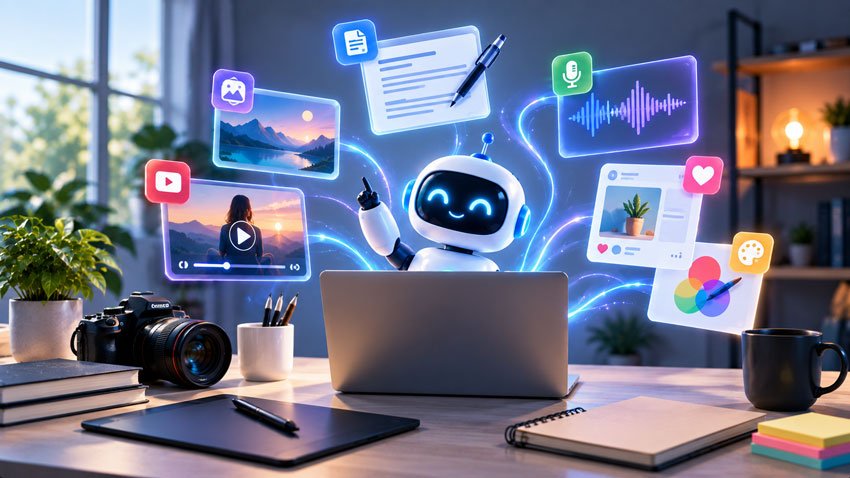
1. ChatGPT — Best for Writing & Ideation
ChatGPT remains the go-to tool for blog posts, ad copy, email sequences, and content brainstorming. Its strength isn’t just generating text — it’s helping you outline ideas, repurpose long content into shorter formats, and refine tone until it matches your brand voice.
Best for: Blog drafts, ad copy, content outlines, brainstorming
Pro tip: Give it your brand voice guidelines and target audience details in the prompt before asking for content — generic prompts produce generic content.
2. Claude — Best for Long-Form & Research-Heavy Content
Claude is particularly strong for longer, well-structured content like guides, reports, and detailed articles that require holding a lot of context accurately. It tends to produce more natural, less repetitive writing over long documents compared to other tools.
Best for: In-depth guides, whitepapers, research summaries
Pro tip: Use it to draft, then edit for local examples, current data, and your own insights so it doesn’t read as purely AI-generated.
3. Canva AI (Magic Studio) — Best for Social Media Design
Canva’s AI features — Magic Design, Magic Write, and background remover — let non-designers create scroll-stopping social graphics, carousels, and ad creatives in minutes. It’s built specifically for marketers, not just designers.
Best for: Social media posts, ad creatives, presentation decks
Pro tip: Feed it your existing brand colors and fonts so every AI-generated design stays consistent with your identity.
4. Midjourney — Best for High-Quality AI Imagery
When you need original, high-impact visuals — for blog headers, campaign concepts, or product mockups — Midjourney remains one of the most detailed and artistic AI image generators available.
Best for: Custom illustrations, campaign visuals, concept art
Pro tip: Write descriptive, specific prompts (lighting, style, mood) rather than short ones — the detail is where Midjourney’s quality shows.
5. Runway — Best for AI Video Editing
Runway has become a staple for marketers producing short-form video content. It can generate video clips from text, remove backgrounds, extend footage, and apply cinematic effects — all without a traditional editing timeline skillset.
Best for: Short-form ads, Reels/Shorts content, video experimentation
Pro tip: Use it to prototype video concepts quickly before investing time in a full production.
6. Jasper — Best for Brand-Consistent Marketing Copy
Jasper is built specifically for marketing teams that need to maintain a consistent voice across dozens of pieces of content. Its brand voice training feature makes it useful for agencies managing multiple clients.
Best for: Multi-brand content teams, agencies, landing page copy
Pro tip: Train it on your best-performing past content so new copy matches what has already converted well.
7. Surfer SEO — Best for AI-Assisted SEO Content
Surfer SEO combines AI writing with real-time SEO scoring, showing you exactly which keywords, headers, and content length to target based on what’s currently ranking. It bridges the gap between “AI-generated” and “actually optimized” content.
Best for: SEO blog posts, content briefs, competitor content analysis
Pro tip: Use its content score as a guide, not a rulebook — always prioritize readability and value over hitting a perfect number.
8. ElevenLabs — Best for AI Voiceovers
For podcasts, video voiceovers, and audio ads, ElevenLabs produces natural-sounding AI voices in multiple languages and accents, making it easy to localize content without hiring voice talent for every version.
Best for: Video voiceovers, audio ads, podcast intros
Pro tip: Use it for first drafts of scripts and localized versions, but disclose AI voice use where required by platform policy.
9. Descript — Best for Podcast & Video Editing
Descript lets you edit video and audio by editing text — delete a sentence from the transcript, and it removes that section from the recording automatically. It also includes AI tools for removing filler words and improving audio quality.
Best for: Podcast editing, webinar repurposing, video transcript-based editing
Pro tip: Use it to quickly turn long-form video or podcast content into short, clippable social media snippets.
10. HubSpot AI (Content Assistant) — Best for Integrated Marketing Content
For marketers already using HubSpot, its built-in AI content assistant helps generate blog ideas, email copy, and landing page content directly inside the CRM, keeping content creation connected to your actual campaign data and audience segments.
Best for: Email campaigns, CRM-connected content, lead nurture sequences
Pro tip: Use audience data from your CRM to guide AI prompts, so content is personalized rather than generic.
How to Choose the Right AI Content Tools for Your Workflow
You don’t need all 10 tools. Instead, map tools to your actual content needs:
- Solo marketer or freelancer: ChatGPT + Canva AI + Surfer SEO covers writing, design, and SEO.
- Agency managing multiple clients: Jasper + Canva AI + Descript for consistent brand voice across accounts.
- Ecommerce or product-based brand: Midjourney + Runway + Canva AI for strong visual and video content.
- Content-heavy publisher or blog: Claude + Surfer SEO for long-form, well-researched, SEO-optimized articles.
Conclusion
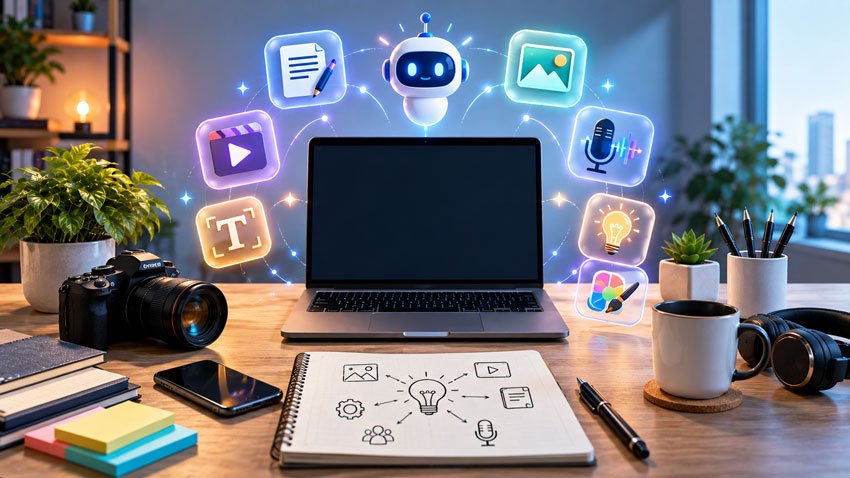
The best AI content tools in 2026 aren’t replacing creativity — they’re removing the friction between an idea and a finished piece of content. The marketers who win aren’t the ones using the most tools, but the ones who understand which tool fits which task, and who still add their own strategy, voice, and edits on top of the AI output.
Pick two or three tools from this list that match your content needs, learn them properly, and build a workflow around them rather than jumping between every new tool that launches.
Frequently Asked Questions
1. Which AI tool is best for beginners in content creation?
ChatGPT and Canva AI are the easiest starting points — both have simple interfaces and cover the two most common needs: writing and design.
2. Are AI-generated blog posts good for SEO?
Yes, if edited properly. Search engines don’t penalize AI content specifically, but they do penalize low-quality, unedited, or unhelpful content. Combining AI drafts with human editing and tools like Surfer SEO produces the best results.
3. Is it necessary to disclose AI-generated content to readers?
It depends on the platform and region. Some platforms require disclosure for AI-generated video or voice content. For blog and social copy, disclosure isn’t usually mandatory, but transparency builds trust with your audience.
4. Can AI tools completely replace a content team?
No. AI speeds up production, but strategy, brand judgment, and quality editing still require human input, especially for content meant to build trust and authority.
5. How much do these AI content tools cost?
Most offer free or low-cost starter plans (ChatGPT, Canva, Descript), while professional plans for tools like Jasper, Surfer SEO, or Runway typically range from $20–$100 per month depending on usage.
6. What’s the difference between ChatGPT and Claude for content writing?
ChatGPT is versatile and widely integrated into other tools, making it great for quick content and ideation. Claude tends to handle longer, more complex documents with better context retention, making it a strong choice for in-depth guides and reports.
